Proprietary blends: how a supplement hides an underdosed formula in plain sight
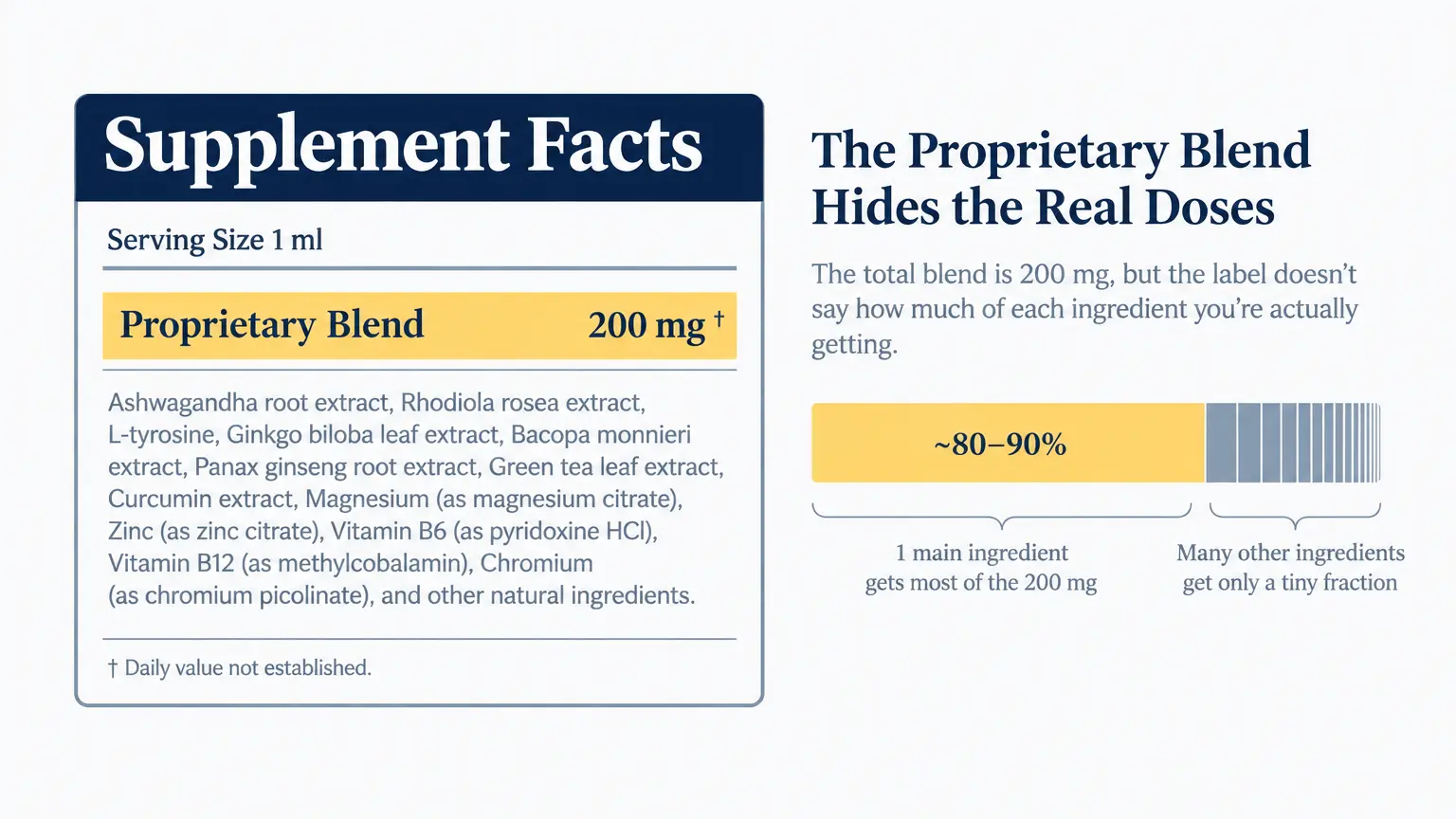
A proprietary blend declares one total weight for a group of ingredients. Individual doses are not required.
In one paragraph
A proprietary blend lets a supplement tell you what is in the bottle without telling you how much. The label states a single combined weight for a group of ingredients and lists them by name. That is legal in the US under 21 CFR 101.36 and permitted under EU food supplement rules. The consequence is arithmetic: divide the blend weight by the ingredient count and you get an average that no single ingredient is guaranteed to meet — and the last ingredient on the list is almost certainly below it.
This guide explains the regulation, works through the maths, and gives you four signals to tell a defensible blend from one built to look comprehensive.
On this page
Supplement labels are read in about nine seconds. Most people scan for a familiar ingredient, see it, and move on. The proprietary blend is designed for exactly that behaviour: it lets a formula list twenty botanicals in the space one ingredient would normally occupy, and it does so without violating any labelling rule.
Understanding the mechanism is not about distrust. It is about being able to tell, in those nine seconds, whether a product is telling you something or performing completeness.
What a proprietary blend is
A proprietary blend is a group of ingredients declared on a Supplement Facts panel as a single line with one combined weight. Instead of:
You get:
The second format tells you the bottle contains 200 mg of those ingredients in total. It does not tell you how the 200 mg is distributed among them. The ingredient list is ordered by weight, so grape seed is present in the largest amount — but "largest" could mean 120 mg or it could mean 12 mg.
This is not a loophole in the sense of a violation. It is an explicitly permitted disclosure format. That distinction matters, because it means you cannot respond by demanding the product be withdrawn. You can only respond by learning to read what the format reveals.
What the law requires — and what it does not
In the United States, dietary supplements are governed by the Dietary Supplement Health and Education Act of 1994 and the labelling regulations at 21 CFR 101.36. The proprietary blend provision sits in 101.36(c)(1)(ii), and it does four things:
- Permits the blend to be declared by total weight. Individual ingredient weights are not required for ingredients in a proprietary blend.
- Requires the ingredients to be listed by name. You are entitled to know what is in it.
- Requires descending order of predominance. The first ingredient is present in the greatest quantity by weight.
- Requires the total blend weight to be stated. You are entitled to the combined figure.
What the regulation does not require is any information about how the total is distributed. There is no minimum dose per ingredient, no requirement that any ingredient reach a level studied in research, and no requirement to disclose whether an ingredient is present at a therapeutically meaningful amount.
The FDA does not review or approve supplement formulas or labels before a product is sold. The manufacturer is responsible for label accuracy. The FDA can act against a product after it reaches market, but there is no pre-market check. This is why the label format matters: it is the only systematic information you receive before buying.
In the European Union
The EU framework is different in structure but reaches a similar outcome. Food supplements are governed by Directive 2002/46/EC, with labelling rules in Regulation (EU) No 1169/2011. Proprietary blends are permitted, and the quantitative ingredient declaration requirements are interpreted inconsistently across member states.
One practical difference: the European Food Safety Authority assesses health claims against the specific ingredient and dose, not against a blend. A claim authorised for an ingredient at 120 mg cannot be transferred to a blend where that ingredient is present at an unknown fraction of a 200 mg total. That is a lever consumers in the EU have that US consumers largely do not.
The arithmetic the label hides
The only calculation a proprietary blend permits is an average, and the average is an upper bound for most of the list, not a description.
Here is why the average is misleading in practice. Because the ingredients are listed in descending order of predominance, the formula is not evenly distributed. A realistic distribution of 200 mg across 22 ingredients might be:
| Position on label | Plausible quantity | What it means |
|---|---|---|
| 1st ingredient | 60–100 mg | Carries most of the blend weight |
| 2nd–5th | 15–40 mg each | Meaningful but below trial doses for most botanicals |
| 6th–12th | 3–12 mg each | Below any dose used in published research |
| 13th–22nd | under 3 mg each | Functionally a label entry, not a dose |
The table is an illustration of a typical distribution, not a claim about any specific product. The principle it shows is real: the average of 9 mg per ingredient describes almost nothing on the label, because the first ingredient is far above it and the last ten are far below.
This is the mechanism that lets a formula look comprehensive. A reader scans the ingredient list, recognises grape seed, green tea, ginseng and GABA, and concludes the product covers a lot. What the reader cannot see is that most of those entries sit at a fraction of any dose ever studied.
Three scenarios side by side
The clearest way to see the problem is to compare three disclosure formats at the same total blend weight. The Whispeara hearing formula is used here because its panel is publicly published and fully reproduced in our full review of that product — it serves as a documented example of the third scenario, not a recommendation.
| Scenario | Blend size | Ingredients | Average per ingredient |
|---|---|---|---|
| Disclosed single ingredient One active, own dose stated | — | 1 | Full stated dose, e.g. 150 mg |
| Defensible blend Few ingredients, large total | 500 mg | 3 | Up to 167 mg average — plausible for some ingredients |
| Crowded blend Many ingredients, small total (Whispeara, documented example) | 200 mg | 22 | ≈ 9 mg average — below research doses for nearly every entry |
The middle row is the case that matters for judgement. A blend is not automatically a concealment device. Three ingredients inside 500 mg can still deliver a defensible dose to each, and a manufacturer using that format may simply be protecting a ratio. The signal of a problem is not the presence of the word "proprietary" — it is the ratio of ingredient count to total weight.
When the ingredient count is high and the total weight is small, the arithmetic stops supporting a real dose for most of the list. Twenty-two ingredients in 200 mg is a formula that cannot deliver eight research doses, because 200 mg divided eight ways is 25 mg — and twenty-two ways is 9 mg. The pattern is structural, not a matter of opinion about any single brand.
Four signals of a problematic blend
You do not need a chemistry background to assess a blend. Four checks cover most of it.
- The ingredient count against the blend weight. Divide the total by the number of ingredients. If the average is far below the dose used in published research for the first two or three ingredients, the rest of the list is functionally decorative. Twenty ingredients in 200 mg averages 9 mg.
- Ingredient order as a claim to test. Because the list is in descending order of predominance, a formula that advertises an ingredient near the bottom of its own list is advertising a trace amount. If the marketing features the tenth ingredient by weight, that is information.
- Whether adjacent ingredients share a mechanism. A blend of three antioxidants is a coherent formula. A blend that mixes stimulants, sedatives, weight-management ingredients and amino acids is not a formula so much as a list — the ingredients work against each other, and the blend format hides that the manufacturer never resolved the contradiction.
- Whether the manufacturer publishes individual doses anywhere else. Some sellers publish a full breakdown on their own site while keeping the blend format on the panel. That is a legitimate reason to use the format. If no dose appears anywhere — not on the label, not on the site, not in a certificate — the blend is doing concealment work rather than protective work.
What this guide does not do
This page contains no affiliate links and no product recommendations. It is part of the editorial side of BalancePhase, published to explain a labelling mechanism rather than to sell anything. If you want to see the method applied to an actual product, the Whispeara review works through a real panel line by line — and reaches a mixed conclusion.
Worked example: the ginkgo dose problem
Ginkgo biloba is the clearest demonstration that brand-agnostic blended doses fail, because it is one of the few botanicals where the clinical dose is well established and the evidence has been tested at that dose.
Trials of standardised ginkgo extract in cognitive and tinnitus research have used 120 to 240 mg of extract per day. That is the dose range that has been studied, and therefore the only range about which any claim can be made.
Now picture a supplement that lists ginkgo as one of fifteen ingredients inside a 300 mg blend. Even if ginkgo were the largest component, it would sit at roughly 60–90 mg — half the lowest studied dose. If it appears sixth on the list, it is closer to 15 mg. In neither case does the published evidence transfer, because the published evidence was never about 15 mg.
This is why the blend format matters more than the ingredient list. A product can truthfully say "contains ginkgo biloba" and simultaneously deliver a dose to which no study applies. Both statements are accurate. Only one of them appears on the label.
It is worth being precise here, because the dose problem is layered on top of an evidence problem. Even at the correct dose, the 2022 Cochrane review pooling twelve studies with 1,915 participants found no evidence that ginkgo biloba has an effect on tinnitus versus placebo. So the underdosing issue is not the only gap — for tinnitus specifically, the evidence does not support the claim at any dose. Dose transparency matters for every ingredient; it does not rescue a claim that was never supported.
What third-party testing does and does not fix
Third-party assays are often presented as the answer to blend opacity. They are a genuine positive signal and they do not solve this specific problem.
| What testing can confirm | What testing does not confirm |
|---|---|
| That a named marker compound is present | The individual dose of every ingredient in a blend |
| That the total quantity of a marker matches the label | Whether any ingredient reaches a research dose |
| Absence of heavy metals, microbes and specific adulterants | That the formula works for the claimed purpose |
| With repeat testing over batches, consistency of the marker | The proportion in which 22 ingredients are distributed |
A certificate of analysis on one marker compound confirms the bottle is not empty and not contaminated. It does not tell you whether the tenth ingredient is present at 0.5 mg or 50 mg. Independence in testing is a trust signal about the manufacturer's process; it is not a substitute for disclosure about the formula.
How to use this when you read a label
Four steps, in order, taking about thirty seconds:
- Find the total blend weight. It is a single number in the Supplement Facts panel, usually in the second column.
- Count the ingredients in the blend. Read the parenthetical list immediately below the blend name.
- Divide one by the other. That number is your ceiling for every ingredient except possibly the first.
- Compare that ceiling against a dose you can verify. If the average is below the dose used in published research for the ingredient you care about, the label does not support a claim about that ingredient.
If the average is below the relevant research dose for the ingredient you came for, the product may still be a legitimate supplement — it simply is not the one the label suggests, and the price should reflect that. That judgement is yours to make with the arithmetic in front of you.
If the average is above the research dose for the first ingredient and below it for the tenth, you know which entry is carrying the formula and which are there for the name.
Frequently asked questions
Is a proprietary blend legal?
Yes. In the United States, 21 CFR 101.36(c)(1)(ii) explicitly permits a dietary supplement to declare a proprietary blend by its total weight rather than by individual ingredient weights. The regulation requires the blend to be listed by weight, the ingredients in descending order of predominance, and the total quantity to be stated. It does not require individual doses.
Why do supplement companies use proprietary blends?
Two stated reasons and one practical one. The stated reasons are protection of a formulated ratio from competitors and the claim that the ratio is the product's intellectual property. The practical consequence is that a formula can include twenty ingredients whose combined weight is small enough that no individual ingredient reaches a dose used in any trial, while the label still names every ingredient.
Can I calculate individual doses from a proprietary blend?
Only an upper bound. Dividing the total blend weight by the number of ingredients gives the average if the blend were evenly distributed. In practice the first ingredient by weight is usually dominant and later ingredients may be present in trace amounts. So the average is not the dose, and the true dose of the last ingredient on the list is almost certainly lower than the average.
Does the EU regulate proprietary blends differently?
Yes, in structure. Under Regulation (EU) No 1169/2011 and Directive 2002/46/EC, labelling rules apply to food supplements and proprietary blends are permitted. However, member states interpret quantitative ingredient declaration inconsistently, and EFSA assesses claims against the specific ingredient and dose rather than the blend — which gives EU consumers a stronger basis to challenge a claim transferred from an individual ingredient to a blended format.
What is the difference between a proprietary blend and a blend with disclosed doses?
A disclosed-dose blend lists each ingredient with its own weight in milligrams or micrograms. A proprietary blend lists the ingredients as a group with one total weight. The first allows you to compare each ingredient against published trial doses. The second does not, which is why an underdosed ingredient can hide inside a formula that looks complete.
Should I avoid every product with a proprietary blend?
Not automatically. A blend can be defensible when the ingredients share a mechanism, when the total weight is large enough that a reasonable average is still a meaningful dose, or when the manufacturer publishes independent third-party assay results. The signal to avoid is a large ingredient count inside a small total weight, because that combination makes a real dose arithmetically implausible for most of the list.
Does the FDA verify supplement labels?
No. The FDA does not review or approve dietary supplement labels, formulas or claims before marketing. Under DSHEA the manufacturer is responsible for the accuracy of the label. The FDA can act after a product reaches market, but there is no pre-market verification, which is why reading the label critically matters more than trusting its presence.
What is a third-party assay and does it fix the problem?
A third-party assay is independent laboratory testing of the finished product for identity, potency and contaminants. It partially addresses the problem because it can confirm the total content of a marker compound. It does not resolve it, because an assay of one marker does not reveal the individual dose of every ingredient in a proprietary blend. It is a positive signal, not a substitute for disclosure.
Where can I see this applied to a real product?
Our Whispeara review reproduces a full Supplement Facts panel with 22 ingredients in a 200 mg blend and works through the arithmetic ingredient group by ingredient group. It is the documented example used in the comparison table above.
About this guide
This is an editorial guide published by BalancePhase. It contains no affiliate links and no product recommendations. It was written and edited under the editorial direction of W. H. Neves, and the assessment method used across the site is documented in our Methodology. Regulatory references are to 21 CFR 101.36, the Dietary Supplement Health and Education Act of 1994, Directive 2002/46/EC and Regulation (EU) No 1169/2011. Nothing here is medical advice.
Sources
- U.S. Code of Federal Regulations, Title 21, Part 101, Section 101.36 — Nutrition labeling of dietary supplements, including subsection (c)(1)(ii) on proprietary blends.
- Dietary Supplement Health and Education Act of 1994 (DSHEA), Public Law 103-417.
- Directive 2002/46/EC of the European Parliament and of the Council on the approximation of the laws of the Member States relating to food supplements.
- Regulation (EU) No 1169/2011 on the provision of food information to consumers.
- Sereda M, Xia J, Scutt P, Hilton MP, El Refaie A, Hoare DJ. Ginkgo biloba for tinnitus. Cochrane Database of Systematic Reviews, 2022.
- Tunkel DE, Bauer CA, Sun GH, et al. Clinical Practice Guideline: Tinnitus. American Academy of Otolaryngology–Head and Neck Surgery, 2014.
Health disclaimer
This guide is for information only and is not medical advice. It does not diagnose, treat or cure any condition and is not a substitute for consultation with a qualified healthcare professional.
Statements about dietary supplements have not been evaluated by the U.S. Food and Drug Administration or the European Medicines Agency. Individual results vary. Discuss any supplement with a clinician or pharmacist, particularly if you take prescription medication or have a diagnosed condition.