How to check whether a supplement claim is backed by evidence
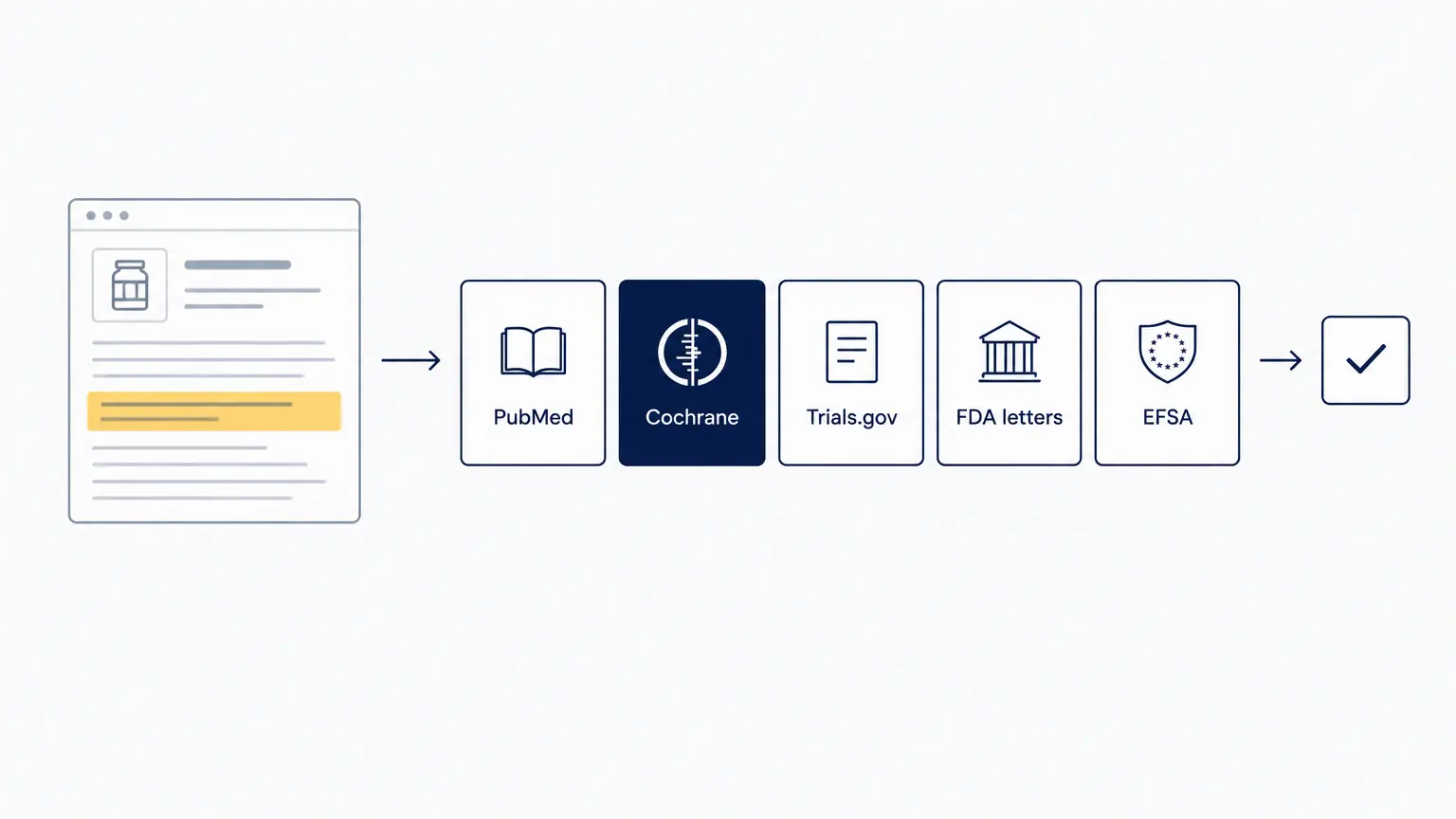
Five primary sources, one method: from the seller's claim to the underlying evidence.
In one paragraph
No authority verifies a supplement claim before it reaches you. In the United States the FDA does not approve supplement formulas, labels or structure/function claims in advance; the manufacturer is responsible for accuracy, and enforcement happens after the product is already on sale. In the EU, claims are assessed centrally but only for authorised wording — not for whether the product delivers what the wording implies.
That means verification is a reader's task, and it is a solvable one. This guide gives you five databases, a five-step method, a way to read an abstract in sixty seconds, and the four errors that make weak evidence look strong.
On this page
A supplement claim is written to sound like a conclusion. "Supports healthy circulation." "Clinically studied ingredient." "Backed by science." Each of those phrases could be true, could be technically true but irrelevant, or could be pure marketing — and the sentence itself gives you no way to tell which.
The only way to distinguish them is to leave the sales page and go to the primary sources. That sounds harder than it is. The entire method fits into a page, and once you have used it twice it becomes automatic.
Why supplement claims are hard to verify
The core difficulty is structural, not a matter of dishonest sellers. Three features of the regulatory system create it.
1. There is no pre-market approval
Under the Dietary Supplement Health and Education Act of 1994, a supplement can be sold without the FDA reviewing its formula, its label or its claims. The manufacturer is responsible for the accuracy of what it prints. The FDA can act after the fact — warning letters, recalls, seizures — but there is no gate before the product reaches the shelf.
This is different from drugs, where a claim of treating a condition requires an approval process with clinical trials. A supplement cannot claim to treat a disease; it can claim to "support" a normal function, which is a much lower bar and requires no evidence submission.
2. Structure/function claims are deliberately vague
Because a supplement cannot claim to treat, prevent or cure a disease, the industry uses structure/function wording: the product "supports", "maintains" or "promotes" a body function. This wording is legal precisely because it makes no specific therapeutic promise — which also makes it hard to test. A claim that a product "supports healthy hearing" cannot be falsified in the way that "improves hearing thresholds by 10 dB" could be.
When a claim is vague by design, the honest question is not "is this true?" but "what specific, measurable claim would this company have to make if it were confident?" If the answer is a number and the page offers a feeling, that gap is the information.
3. The evidence that exists is often about something else
Most supplement ingredients have some published research. The question is whether that research studied the ingredient at a comparable dose, in a comparable population, for the outcome being claimed. Frequently it did not — it studied a different dose, a different population, or a marker in a laboratory dish. The citation is real; the connection is not.
The five databases that matter
You do not need to know the literature. You need to know where to look and what each source can answer.
| Source | What it answers | Best for |
|---|---|---|
| PubMed pubmed.ncbi.nlm.nih.gov | What studies exist on this ingredient, subject and outcome | Finding the primary literature, checking whether a cited study exists and what it actually says |
| Cochrane Library cochranelibrary.com | What the pooled evidence says, after weighing study quality | Questions where a systematic review exists — the fastest reliable answer |
| ClinicalTrials.gov clinicaltrials.gov | What has been tested in humans, including trials that were never published | Checking whether a human trial exists at all; spotting registered trials with no published result |
| FDA warning letters fda.gov enforcement | Whether a company has been cited for its claims | Checking the seller's regulatory history and the wording that triggered action |
| EFSA claims register EU register of health claims | Whether a claim is authorised in the EU, and on what basis | Understanding why a claim is worded the way it is; identifying claims that were assessed and rejected |
Two of those five answer most questions. If a Cochrane review exists, it is usually the fastest path to a reliable answer, because it has already done the work of gathering and weighting the trials. If no review exists, PubMed and ClinicalTrials.gov between them tell you whether human evidence exists at all.
None of these sources verifies a specific product. They tell you what is known about an ingredient at a dose. Connecting that to a bottle requires the label — which is why reading the label comes first, described in our guide to proprietary blends.
The five-step method
Applied in order, this takes about ten minutes for a product you are seriously considering.
- Extract the claim as a testable sentence. Take the marketing language and rewrite it as something that could be proven false. "Supports hearing clarity" becomes "improves hearing thresholds or reduces tinnitus severity in adults". If you cannot rewrite it as a testable sentence, the claim is unfalsifiable by design — note that and move on.
- Identify the ingredient and the dose. Not the product name — the actual compound and its quantity per serving. If the dose is hidden inside a proprietary blend, the claim cannot be evaluated, because the evidence applies to doses and you do not have one. That is the most common dead end, and it is worth knowing immediately.
- Search Cochrane first. Query the ingredient plus the outcome. If a systematic review exists and is current, read its plain-language summary. That is often the whole answer, and it takes three minutes.
- If no review exists, search PubMed and ClinicalTrials.gov. Look for randomised controlled trials in humans. Note the number of trials and their size. A single small trial is a data point, not a conclusion.
- Compare the studied dose to the label dose. This is the step most people skip, and it is where most claims collapse. If the trials used 240 mg of extract and the label delivers 15 mg inside a blend, the evidence does not transfer. The study is real; the application is not.
Reading an abstract in 60 seconds
An abstract is a compressed summary, and most of what matters sits in five places. Read them in this order.
| Check | What to look for | Red flag |
|---|---|---|
| 1. Study type | Randomised controlled trial, systematic review, observational study, animal study, in vitro | Cell-culture or animal data presented as evidence for a human claim |
| 2. Sample size | Number of participants | Under ~30 per arm; small samples produce unstable results |
| 3. Dose and form | Exactly how much, of what extract, for how long | Dose not stated, or a form different from the product |
| 4. Outcome measured | What was actually measured, and whether it is the thing you care about | A blood marker or scan finding instead of a symptom or function |
| 5. Funding and conflicts | Who paid, and whether authors are industry-affiliated | Industry-funded with no independent replication |
Two additional signals are worth checking once you have the paper open. Was it placebo-controlled and blinded? A trial without those controls cannot separate the ingredient from expectation. Is the result statistically significant, and is the effect size meaningful? A statistically significant change can be so small that no person would notice it, and abstracts often report the first while omitting the second.
The four interpretation errors
These are the specific moves that turn weak evidence into a confident claim. Knowing them is most of the work.
1. Laboratory evidence presented as clinical evidence
A study showing that a compound reduces oxidative stress in cultured cells is real science and almost irrelevant to a person taking a capsule. The molecule must survive digestion, be absorbed, reach the target tissue, and reach it at a concentration the study never tested. In vitro findings generate hypotheses; they do not confirm outcomes.
2. The dose mismatch
The most common and most consequential. The trial used 240 mg; the product contains 15 mg inside a blend. The citation is real and the claim built on it is not. Whenever you see a study referenced without a dose, check the dose — this is where the argument usually breaks.
3. The surrogate endpoint
A surrogate endpoint is a measured change that stands in for what the person actually wants. A drop in a blood marker, a change on a scan, an increase in a biomarker. What the person wants is to feel better or function better. A product can move a marker without changing a symptom, and both statements can be accurate while only the first appears in the marketing.
4. Population extrapolation
A trial in healthy young adults is not automatically evidence for people over sixty. A trial in people with a diagnosed deficiency is not evidence for people without one. The population studied defines the population to which the result applies, and that boundary is routinely ignored.
The most confident supplement claims tend to combine all four: a laboratory finding, at an unstated dose, on a surrogate marker, in a population that does not match the buyer. The combination is not rare. It is the standard structure of supplement marketing, and it is legal because each individual element is truthful.
What counts as stronger evidence
Evidence is not binary. It sits in a hierarchy, and the position of a study in that hierarchy determines how much weight it can carry.
| Level | Study type | What it can support |
|---|---|---|
| 1 | Systematic review / meta-analysis of randomised trials | The strongest statement available about whether an effect exists |
| 2 | Randomised controlled trial | A causal claim in the population studied, at the dose studied |
| 3 | Observational study (cohort, case-control) | An association — not causation |
| 4 | Animal study | A hypothesis about a mechanism |
| 5 | In vitro / laboratory study | A mechanism in isolation, with no implication for a person |
| — | Testimonial, anecdote, "traditionally used" | Nothing about efficacy |
A claim supported only by level 4 and 5 evidence is a hypothesis. A claim supported by a current level 1 review is about as settled as this field gets. Most supplement claims sit at level 5, presented in the language of level 1.
Worked case: ginkgo and tinnitus
Ginkgo biloba is a useful case because it is the most-studied botanical in the hearing category, which means the method has something real to work with at every step.
Step 1 — the claim, made testable. "Supports hearing health" becomes "reduces tinnitus severity or improves hearing thresholds in adults with tinnitus".
Step 2 — the ingredient and dose. Standardised ginkgo biloba extract. Trials have used 120 to 240 mg per day.
Step 3 — Cochrane. The 2022 systematic review pooled twelve studies with 1,915 participants and found no evidence that ginkgo biloba has an effect on tinnitus versus placebo. The review is current enough to be authoritative on this question.
Step 4 — corroboration. The American Academy of Otolaryngology–Head and Neck Surgery clinical practice guideline carries an explicit recommendation against dietary supplements for persistent, bothersome tinnitus. That is stronger than "insufficient evidence" — it is a recommendation not to use them. The most recent synthesis, published in Laryngoscope Investigative Otolaryngology in April 2026, pooled nine randomised trials with 390 adults and found findings inconsistent with common placebo responses, concluding that no firm conclusions are possible on over-the-counter therapies.
Step 5 — dose match. Here the method produces a second, separate finding. Even if the evidence were favourable, most hearing supplements place ginkgo inside a blend that delivers a fraction of the studied dose. So the problem is layered: the evidence does not support the claim at the studied dose, and the products mostly do not reach the studied dose anyway.
Two independent grounds for scepticism, from a single method, in under fifteen minutes. Not one of them required reading a full paper. The level 1 review and the clinical guideline between them settle the question — and the dose comparison explains why the label's ingredient list does not rescue it.
Where this method is applied in practice
This guide contains no affiliate links. If you want to see the same five steps applied to a specific product's panel, the Whispeara review walks through the label and the evidence separately and states where each conclusion comes from. It is an example of the method, not a recommendation.
No evidence vs. evidence of no effect
These two phrases are treated as synonyms and they are not. The distinction determines what you should actually conclude.
| Situation | What it means | What to conclude |
|---|---|---|
| No evidence exists | No adequately designed human trial has tested the claim | Unknown. The claim is a hypothesis, and you are paying for a possibility |
| Evidence of no effect | Trials were run and found no benefit over placebo | The claim is not supported at the dose tested. This is a finding, not a gap |
| Mixed evidence | Some trials positive, some not, quality varies | Uncertain. The honest statement is that the evidence is inconsistent |
| Evidence at a different dose | Positive trials exist, but at doses the product does not deliver | Not applicable to this product. The evidence belongs to another dose |
For most supplement ingredients the honest position is the first row: untested for the claim being made. That is not the same as disproven, and saying so is not cynicism — it is precision. The second row is stronger and rarer: ginkgo and tinnitus is an example, because the question was asked properly and answered negatively.
What follows from this is proportional. The stronger the claim and the higher the price, the more evidence should exist before buying. When no evidence exists, you are not buying an effect; you are buying the possibility of one, priced as though it were established.
What to do with the answer
Verification produces one of four outcomes, and each has a different sensible response.
- Evidence exists at the dose you would take. The claim is supportable. Whether the price is justified is a separate question, but the claim itself survives scrutiny.
- Evidence exists at a different dose. The product is not the one the evidence describes. Either find a product at the studied dose, or accept that you are buying without the evidence.
- Evidence exists and shows no effect. This is the clearest case. No further reasoning is required — the question has been asked and answered.
- No evidence exists either way. The most common outcome. Here the decision rests on everything else: price, guarantee, label transparency and whether you accept the risk of paying for an untested premise.
The result of this method is rarely certainty. It is a clearer sense of which claims have been tested and which have not — and that distinction is what separates reading a label from being persuaded by one.
Frequently asked questions
Does the FDA approve supplement claims?
No. Dietary supplements are not approved by the FDA before marketing. Structure/function claims — statements that a product supports a normal body function — do not require pre-market authorisation, but must be truthful and not misleading, and must carry the disclaimer that the statement has not been evaluated by the FDA. Disease claims, which state that a product treats or prevents a condition, require the product to be regulated as a drug. A claim's presence on a label tells you nothing about whether it has been verified.
What is the difference between "no evidence" and "evidence of no effect"?
Absence of evidence means no adequately conducted study has tested the question, so we do not know. Evidence of absence means studies were conducted and found no effect. The two are frequently treated as the same and are not. For many supplement claims, the honest position is the first. For some, including ginkgo biloba and tinnitus, it is the second — a systematic review with a substantial pooled sample found no benefit versus placebo.
Is a single study enough to confirm a supplement works?
No. A single study is one data point, and a large share of published findings are not reproduced. The hierarchy matters: a systematic review that pools several randomised trials carries far more weight than one trial, and one randomised controlled trial carries more than an observational study, which carries more than laboratory work. If a seller cites one study, check whether it has been replicated and whether a review has pooled it.
How do I read a PubMed abstract quickly?
Check five things in order: study type, sample size, population, intervention dose, and whether the abstract reports a significant result on the outcome you care about. Then check whether the study was randomised, placebo-controlled and blinded. Finally check the funding source and stated conflicts of interest. If the abstract does not state the dose, the study cannot support a claim that depends on that dose.
Why do supplement pages cite laboratory studies?
Because in vitro and animal studies are cheaper and faster than human trials and produce results readily. A test-tube study showing reduced oxidative stress in cultured cells does not establish that swallowing the compound produces the same effect in a person, where the molecule must survive digestion, be absorbed, reach the target tissue and reach it in sufficient concentration. Laboratory findings generate hypotheses; they do not confirm outcomes.
What is a surrogate endpoint and why does it matter?
A surrogate endpoint is a measured change that stands in for the outcome a person actually cares about — a blood marker, a biomarker, a scan finding. The outcome people care about is feeling or functioning better, and those are not automatically the same thing. A supplement can move a marker without changing a symptom, and both statements can be reported accurately while only the first is used in the marketing.
What does the Cochrane Library add that PubMed does not?
Cochrane publishes systematic reviews that gather all studies meeting pre-specified criteria on a defined question, assess their risk of bias, and pool results where possible. PubMed indexes individual studies rather than synthesising them, so searching it returns a long list with no built-in reliability ranking. When a Cochrane review exists, it is faster and more reliable than assembling the trials yourself.
Can a supplement be effective even if no evidence exists?
Logically yes: something untested could still work. But an untested claim is a hypothesis, not a basis for purchase. The position that makes sense for a consumer is proportional — the stronger the claim and the higher the price, the more evidence should exist before buying. In the absence of evidence, you are paying for the possibility of an effect, with no way to tell from inside the product whether it exists.
What should I do if the seller refuses to disclose the formula?
Treat non-disclosure as a signal in its own right. Under 21 CFR 101.36 a proprietary blend must disclose the total weight and list the ingredients, so a fully hidden formula is a labelling problem rather than a legitimate protection of trade secrets. If even the ingredient names and blend weight are unavailable, no evidence assessment is possible, and a product whose claim cannot be assessed should not be purchased on the basis of that claim.
How long does this method take?
About ten minutes for a product you are seriously considering, and under five if a Cochrane review exists on the question. The first two steps — rewriting the claim as a testable sentence and finding the dose — take the longest, because they require patience with a page designed to be read quickly. The remaining three steps are lookups.
About this guide
This is an editorial guide published by BalancePhase. It contains no affiliate links and no product recommendations. It was written and edited under the editorial direction of W. H. Neves, and the assessment method used across the site is documented in our Methodology. Regulatory references are to the Dietary Supplement Health and Education Act of 1994, 21 CFR 101.36, Directive 2002/46/EC and Regulation (EU) No 1169/2011. Evidence references are listed below. Nothing here is medical advice.
Sources
- Dietary Supplement Health and Education Act of 1994 (DSHEA), Public Law 103-417.
- U.S. Code of Federal Regulations, Title 21, Part 101, Section 101.36 — Nutrition labeling of dietary supplements.
- U.S. Food and Drug Administration — Structure/Function Claims: Small Entity Compliance Guide, and FDA Warning Letters database (fda.gov).
- Directive 2002/46/EC of the European Parliament and of the Council on food supplements.
- Regulation (EU) No 1169/2011 on the provision of food information to consumers.
- European Food Safety Authority — EU Register of Nutrition and Health Claims Made on Foods.
- Sereda M, Xia J, Scutt P, Hilton MP, El Refaie A, Hoare DJ. Ginkgo biloba for tinnitus. Cochrane Database of Systematic Reviews, 2022.
- Tunkel DE, Bauer CA, Sun GH, et al. Clinical Practice Guideline: Tinnitus. American Academy of Otolaryngology–Head and Neck Surgery, 2014.
- Effectiveness of Over-The-Counter Treatments for Tinnitus Symptom Relief: A Systematic Review. Laryngoscope Investigative Otolaryngology, April 2026; 11(2):e70398.
- U.S. National Library of Medicine — PubMed and ClinicalTrials.gov, methodology and indexing documentation.
Health disclaimer
This guide is for information only and is not medical advice. It does not diagnose, treat or cure any condition and is not a substitute for consultation with a qualified healthcare professional.
Statements about dietary supplements have not been evaluated by the U.S. Food and Drug Administration or the European Medicines Agency. Individual results vary. Discuss any supplement with a clinician or pharmacist, particularly if you take prescription medication or have a diagnosed condition.