The supplement guarantee that protects no one
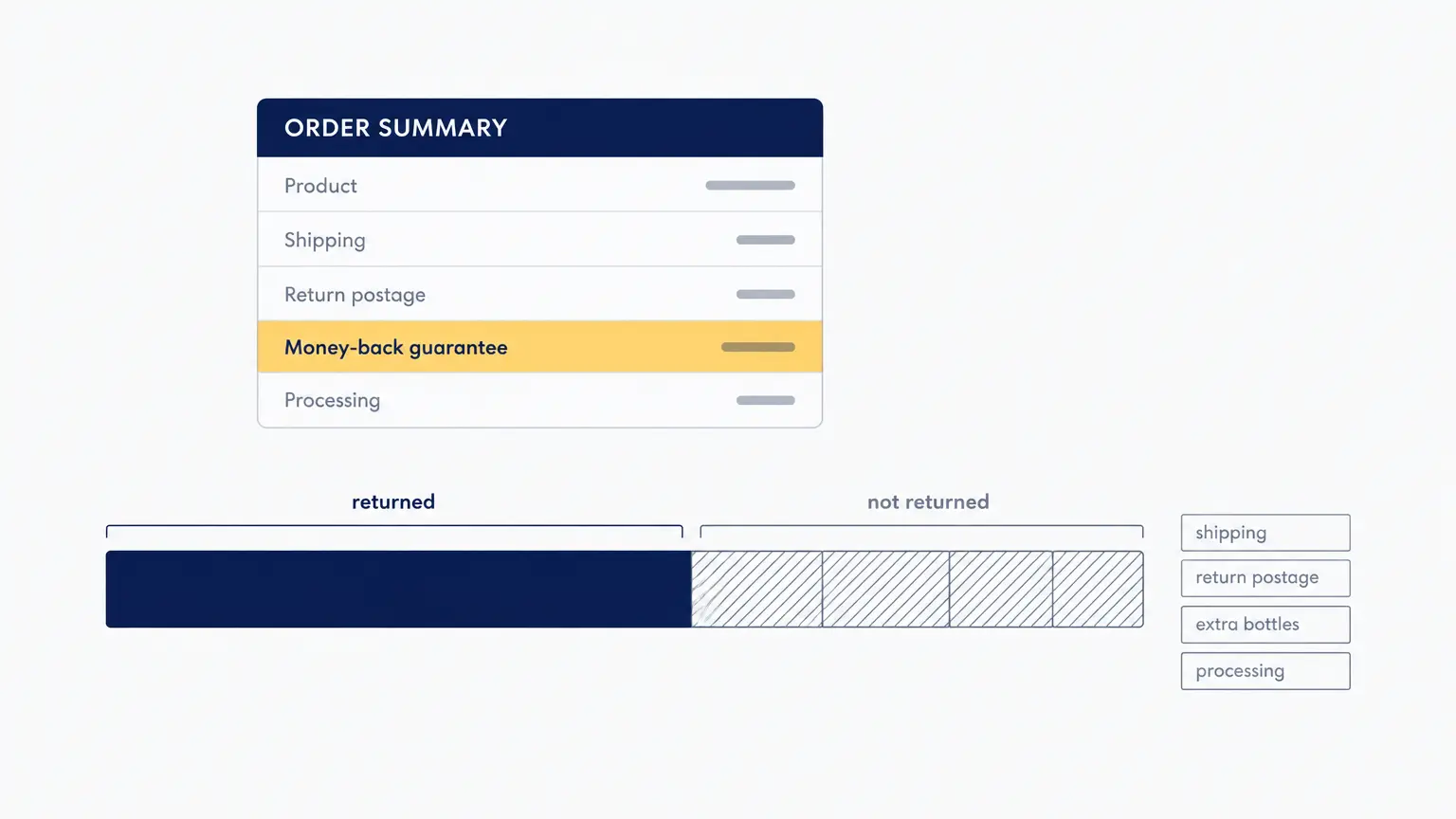
"Money-back guarantee" refunds the product. The rest of what you paid is a different question.
In one paragraph
A 90-day money-back guarantee is the single most cited reason to trust a supplement seller, and the least examined. In the overwhelming majority of published terms it refunds the product price only — not the shipping, not the return postage, often not the additional bottles. The window generally counts from purchase rather than delivery. And the seller offering it knows that only a minority of buyers ever ask.
None of this is fraud. It is a commercial instrument calibrated to raise conversion while costing less than it earns. This guide takes it apart clause by clause, shows what a guarantee that actually protects a buyer would look like, and explains the one mechanism that does protect you when the guarantee fails.
On this page
Every supplement sales page has the same three moves. A problem you recognise, an ingredient list that sounds researched, and a guarantee that removes the risk of trying. The first two are debated endlessly on review sites. The third is quoted once and never questioned.
That asymmetry is strange, because the guarantee is the only claim on the page that describes something the seller will actually do, in writing, if you ask. It should be the most scrutinised element, not the least.
This guide is about reading it.
What "90 days" actually promises
Start with the wording, because the gap between what a buyer assumes and what the terms say is where the entire mechanism lives.
| What buyers assume | What standard terms say | |
|---|---|---|
| Amount refunded | Everything they paid | The product price. Original shipping is commonly excluded |
| Window start | When the product arrived | When the order was placed |
| Additional bottles | All units in the order | Frequently the first unit only |
| Return shipping | Covered by the seller | Paid by the buyer |
| Condition | Whatever state it is in | All bottles returned, including empties, within a stated period |
| Timing of refund | On approval | After processing, which is often 10 to 30 days |
None of those columns is hidden. They sit in the terms page, in a paragraph under a heading most buyers never open. The guarantee's persuasive force comes from the headline, and its cost is contained in the detail.
Before buying, find the sentence that defines what is refunded. Not the badge on the sales page — the sentence. If it says "purchase price" rather than "total amount paid", the difference is your shipping, and it does not come back.
The five clauses that empty it
Individually, each of these is a reasonable commercial condition. Together, they can reduce a refund from a reassuring figure to a fraction of it.
1. Only the first bottle is refundable
Bulk pricing exists to move buyers from one bottle to three. The guarantee is often scoped to the first unit, with the rest excluded by name. That means the orders where the guarantee mattered most — the expensive ones — are the orders where most of the money is outside it.
2. The window runs from purchase
A 90-day window counted from the order date is shorter than it sounds. Shipping takes a week or two. People set products aside before starting. By the time a genuine trial has run long enough to judge anything, a meaningful portion of the window is spent.
3. Return postage is yours
Some terms require the product back before refunding. The return shipment is then a cost you carry, and it is a cost that increases with the weight of a multi-bottle order — precisely at the point where you are most likely to abandon the claim.
4. Everything must come back, including empties
If a single bottle must be returned to get the refund, terms frequently require all of them. Buyers who have finished one bottle and thrown away the packaging find themselves unable to comply, and the claim fails on condition rather than on merit.
5. Refund processing has its own clock
A refund approved is not a refund received. Ten to thirty days of processing is common, and during that period the burden of chasing sits with the buyer. Some fraction of claims simply stops being followed up.
Take a three-bottle order. Only the first is refundable, so two thirds of the product value is out at clause one. The refund excludes shipping, which is out at the terms' refund definition. You pay to return the unit, which is out at clause three. What returns is a partial sum, weeks later, after a process that required you to keep packaging you had already discarded. That is a guarantee that functions as designed — and the design was not to protect you.
Why it is a conversion tool
The reason a seller can offer a generous-sounding guarantee is that the numbers support it. The mechanism is straightforward once you look at it as the seller does.
Three factors drive that inequality, and all three work in the seller's favour:
- Most buyers never claim. A refund has to be requested, and requesting requires effort. The majority of dissatisfied buyers simply stop buying rather than open a claim — which costs the seller nothing.
- Some claims fail on procedure. Packaging discarded, window elapsed, incorrect form filled, return not shipped in time. Each of these converts an eligible claim into a zero.
- The guarantee lifts conversion on everyone. It is shown to every visitor, while it is only paid to the small fraction who complete the process. The arithmetic is not close.
A guarantee is not a promise the product works. It is a promise the seller can afford to make.
This is not a criticism of any particular company. It is the structure of the instrument. A guarantee that was genuinely adverse to the seller — no return required, full amount including shipping, from delivery date — would reduce claims friction to near zero and would cost considerably more. Companies that offer it exist, and they are the exception, not the rule.
What a robust guarantee would look like
Four features distinguish a guarantee that protects a buyer from one that persuades one. They are testable against any terms page in about two minutes.
| Feature | Weak version | Strong version |
|---|---|---|
| Window start | From purchase | From delivery |
| Amount | Product price only | Full amount paid, including shipping |
| Return required | All bottles, buyer pays postage | No return required |
| Processing | 10 to 30 days after approval | Stated short period, with a date |
| Scope | First unit only | Entire order |
A guarantee carrying three or more of the strong-column features is genuinely adverse to the seller and therefore genuinely informative. One carrying two or fewer is a marketing instrument — still better than nothing, but not a reason to trust a label.
No product needs a ninety-day window if the evidence is strong. A guarantee this long, this prominent, and this rarely exercised is doing persuasive work that the label is not doing. When a page leads with the refund rather than the formula, that ordering is the message.
The protection behind the guarantee
When a refund is refused or the terms are applied in a way that contradicts what was advertised at the point of sale, the guarantee has failed. What remains is the card.
A chargeback is a dispute raised with the card issuer, not with the seller. Card network rules give cardholders a defined window to dispute a transaction — commonly around 120 days from the transaction date or from when the issue should reasonably have been noticed, though the exact period varies by network, issuer and country.
Two conditions make a chargeback viable in this situation:
- Document the terms as they were at purchase. Screenshot the guarantee as advertised on the day you bought. If the terms later change, your evidence is what you captured.
- Show the attempt. Keep the refund request, the seller's response and the dates. A dispute is strengthened considerably by a documented attempt to resolve it directly.
The chargeback is the reason a weak guarantee is not a catastrophe. It is also the reason a guarantee is not the strongest thing to check: the card issuer's protection operates independently, and it does not depend on the seller's goodwill.
Six things to check before buying
In order, and each takes less than a minute.
Screenshot the terms page once you have done this. It costs nothing and it is the evidence you will wish you had.
What matters more than the guarantee
A guarantee tells you what happens if the product disappoints. It says nothing about whether it will. Three other things tell you more about the product itself.
Price per day, not price per bottle
A three-bottle bundle at a discount is a price. Divide by the serving count to get the number that actually matters, then compare across products. This is where bulk discounts stop looking like discounts.
A disclosed dose for every ingredient
A formula that publishes each quantity can be assessed against the evidence. One that hides them inside a proprietary blend cannot be assessed at all — a point set out in our guide to proprietary blends. No guarantee compensates for a dose you cannot see.
The evidence at that dose
Whether the ingredients have been studied in humans, at a comparable dose, on the outcome being claimed. The method for checking this is in the evidence guide, and the reason "clinically studied" is not a substitute is in the claim guide.
What this guide does not do
This page contains no affiliate links and names no company. It describes the structure of a commercial instrument, not the conduct of a particular seller. Where a review on this site assesses a product that offers a guarantee, the review states the terms as published and links here rather than repeating this analysis.
Frequently asked questions
Does a 90-day money-back guarantee cover shipping?
In most published terms, no. The standard clause refunds the product price only. Original shipping is typically excluded and the cost of returning the product is paid by the buyer. On a three-bottle order, shipping in both directions can represent a meaningful share of what was paid, and none of it is recoverable. Read the refund definition before assuming the full amount returns.
When does the 90-day window start?
Almost always on the date of purchase, not delivery. This matters more than it appears: if shipping takes ten days and the product sits unopened for a fortnight, roughly three weeks of the window are gone before the trial begins. Guarantees counted from delivery are rarer and materially more generous.
Can I get a refund on additional bottles?
Frequently not. A common structure refunds only the first unit in a multi-bottle order, excluding the rest by name. Because bulk pricing is the main reason people order three or six bottles at once, this clause removes most of the refundable value from exactly the orders where the guarantee was most persuasive.
Do I have to return the product to get a refund?
Usually yes, and often all of it including empties. The physical return creates two costs: the postage and the administrative friction. Some terms require the return within a short period after the request, so a buyer who discarded packaging can lose the claim on a technicality rather than on substance.
Why do sellers offer guarantees at all?
Because a guarantee raises conversion by more than it costs. Only a minority request a refund, and some of those fail to complete the steps. Meanwhile the guarantee removes the buyer's main objection at the point of sale. It is priced as a marketing expense, calibrated to cost less than the revenue it unlocks.
What would a genuinely strong guarantee look like?
Four features: the window counts from delivery; the refund covers the full amount paid including shipping; no physical return is required; and there is no processing delay designed to discourage follow-up. A guarantee missing two or more of these is a marketing instrument rather than consumer protection.
What can I do if the seller refuses a refund?
The card issuer is the practical recourse. A chargeback disputes the transaction on the grounds that the goods or the promised terms were not delivered as described. Card network rules give a defined dispute window, commonly around 120 days from the transaction or from when the issue should reasonably have been noticed, varying by network and issuer. Document the guarantee as published at purchase and open the dispute before the window closes.
Should a guarantee influence my decision to buy?
Less than a disclosed dose should. A guarantee tells you what happens if the product disappoints, not whether it will. Two products can carry identical 90-day terms while one discloses every dose and the other hides them in a blend. The label and the evidence describe the product; the guarantee describes the exit.
Is a longer guarantee better?
Not on its own. A 90-day window scoped to the first bottle and excluding shipping can return less than a 30-day window covering the full order. The length is the number the page advertises; the scope is the number that determines what you get. Compare scope first, length second.
About this guide
This is an editorial guide published by BalancePhase. It contains no affiliate links and names no company. It was written and edited under the editorial direction of W. H. Neves, and the assessment method used across the site is documented in our Methodology. References are to the Federal Trade Commission's rules on advertising substantiation, Directive 2011/83/EU on consumer rights, and published card network chargeback rules. Nothing here is legal or medical advice.
Sources
- Federal Trade Commission — Advertising and Marketing on the Internet: Rules of the Road, on substantiation of advertised offers.
- Directive 2011/83/EU of the European Parliament and of the Council on consumer rights, including withdrawal periods for distance contracts.
- The Consumer Contracts (Information, Cancellation and Additional Charges) Regulations 2013 (United Kingdom), on cancellation rights for distance sales.
- Directive 2005/29/EC on unfair business-to-consumer commercial practices.
- Card network chargeback rules and cardholder dispute time limits, as published by the major payment networks.
- U.S. Federal Trade Commission — consumer guidance on disputing credit card charges and on return and refund policies.
Health disclaimer
This guide is for information only and is not medical, financial or legal advice. It does not diagnose, treat or cure any condition and is not a substitute for consultation with a qualified professional.
Statements about dietary supplements have not been evaluated by the U.S. Food and Drug Administration or the European Medicines Agency. Individual results vary. Discuss any supplement with a clinician or pharmacist, particularly if you take prescription medication or have a diagnosed condition.