Akemi Coffee Boost Review: 7 ingredients named, 1 dose published
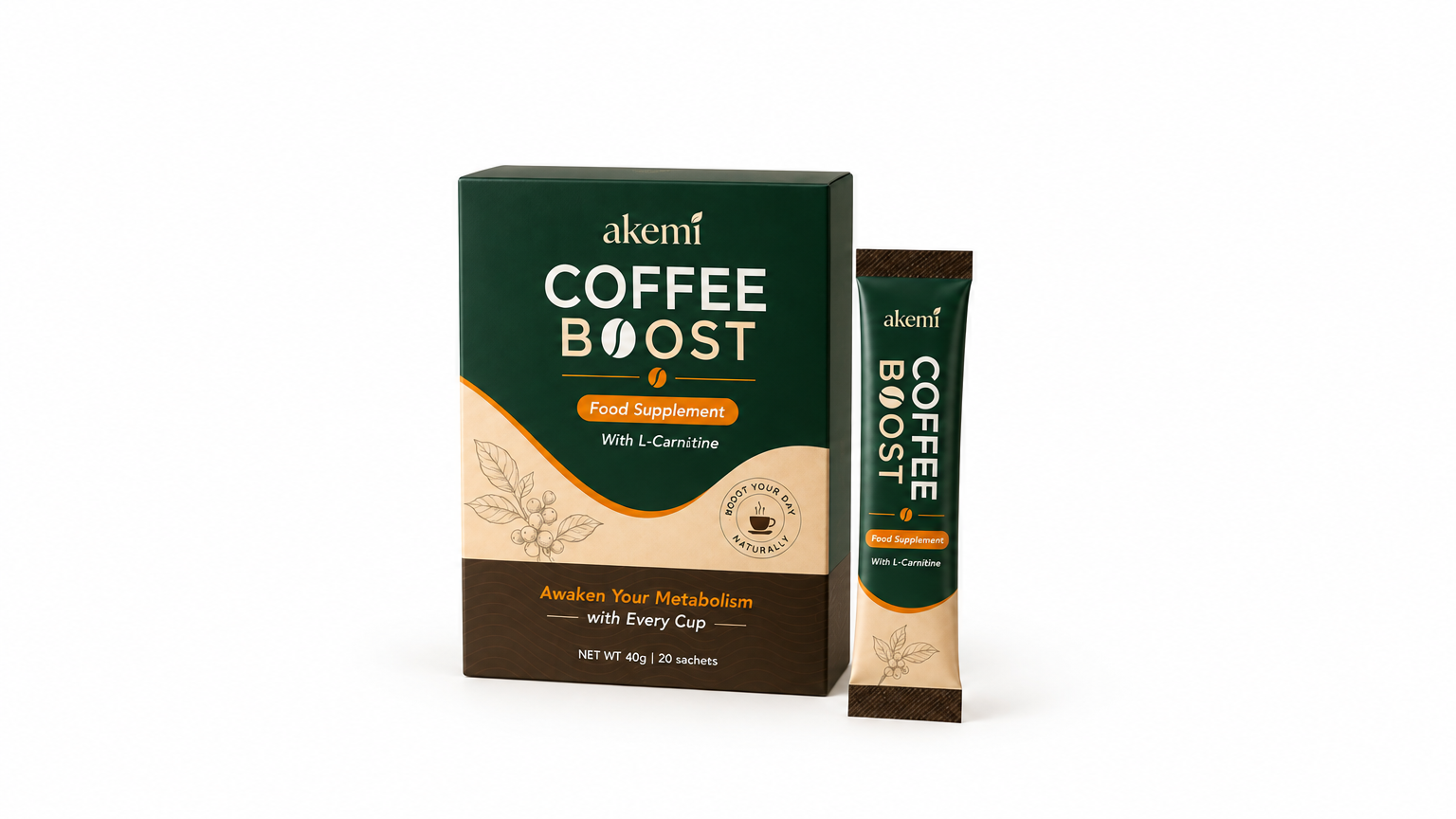
Akemi Coffee Boost — powdered food supplement, 20 sachets per box, labelled NET WT 40 g
The short answer
This is the opposite problem to a hidden blend. Seven ingredients are named on the packaging, and not one of them carries a published quantity. There is no proprietary blend to hide behind either — there is simply no number. Without a dose, nothing can be checked against published research, and cost per milligram cannot be calculated at all.
The second finding is arithmetic, not opinion. The box contains 20 sachets. One sachet is one serving. The checkout sells that same box as a 30-day supply and calculates every per-day figure on 30 days per box. At one sachet a day it lasts 20 days, so the real cost per day is 50% higher than the number on the package card.
On this page
- What the product is
- The label: seven names, no numbers
- The caffeine question
- Twenty sachets, sold as thirty days
- Price and the real cost per day
- The $66.64 reference price
- Two review counts on the same site
- The testimonials
- What the guarantee covers
- Regulation: what the FDA does and does not do
- Honest limits
- Who it suits, and who should skip it
- FAQ
- Verdict
What the product is
Akemi Coffee Boost is a powdered food supplement sold in sachets, one a day, stirred into coffee or water. The front of the box carries the line With L-Carnitine, the promise Awaken Your Metabolism with Every Cup, and the specification NET WT 40 g / 20 sachets. It is sold only through the brand's own checkout, not in retail.
The category matters here. A coffee booster is usually built on caffeine plus green tea or green coffee extract, sometimes with a fibre for satiety. This one names those and adds white kidney bean, mulberry leaf, L-carnitine L-tartrate and resistant dextrin — seven ingredients chosen to sound as though they act on several pathways at once. Whether they do depends entirely on how much of each is in the sachet, and that is the one thing the label does not say.
The label: seven names, no numbers
Most reviews of this product repeat the same list of seven ingredients. What none of them point out is that the list is names only. There is no Supplement Facts panel with quantities anywhere in the material we reviewed — no individual amount, and no blend total either.
| Ingredient as published | Named on the label | Quantity published |
|---|---|---|
| Green tea extract | Yes | None |
| Green coffee bean extract | Yes | None |
| White kidney bean extract | Yes | None |
| Mulberry leaf extract | Yes | None |
| L-carnitine L-tartrate | Yes — highlighted on the front | None |
| Resistant dextrin | Yes | None |
| Psyllium husk | Yes | None |
A dose is what makes an ingredient claim testable. Green tea extract at 500 mg and green tea extract at 50 mg are different products: one can be compared with the trials that gave the ingredient its reputation, the other cannot. On this label there is nothing to compare. That does not make the formula dishonest — it makes it unbuyable on evidence, and it means the price cannot be broken down to a cost per milligram the way it can on a label that publishes its amounts.
Note the specificity that is present. The fifth ingredient is not listed vaguely as “L-carnitine” but as L-carnitine L-tartrate, a named salt form with a documented absorption profile. That is a credential-grade detail, and it sits beside six entries with no quantity at all. The label knows how to be precise. It chooses not to be precise about amounts.
Compare this with a proprietary blend, where at least a total weight is declared and the arithmetic can be attempted. Here even that is absent. The omission is one step further back.
The caffeine question
Two of the seven named ingredients — green tea extract and green coffee bean extract — naturally contain caffeine. The product is sold as a coffee booster, so a buyer would reasonably expect to know how much they are taking. The packaging we reviewed does not state it.
Some third-party reseller pages quote a figure of roughly 30 mg per sachet. That figure does not appear on the box, on the front panel, or anywhere in the checkout we examined. We report it as an unconfirmed third-party number, not as a manufacturer declaration.
If it is around 30 mg, that is a modest dose — roughly a third of a cup of filter coffee — and it supports a “gentle energy, no jitters” positioning honestly. If it is higher, the opposite. For anyone limiting caffeine for sleep, blood pressure, pregnancy or a medication interaction, the difference between 30 mg and 120 mg is the difference between a product they can take and one they cannot. The label does not let them decide.
Twenty sachets, sold as thirty days
This finding takes one line to state. The box says 20 sachets. The checkout calls the same box a 30-day supply and a monthly supply. One sachet a day is twenty days.
The discrepancy repeats across every package. Two boxes hold 40 sachets and are sold as a 60-day supply. Three boxes hold 60 sachets and are sold as a 90-day supply. In each case the stated supply is 50% longer than the product can deliver at the stated serving of one sachet per day.
| Package | Boxes | Sachets | Sold as | Actually covers |
|---|---|---|---|---|
| Starter | 1 | 20 | 30-day supply | 20 days |
| Two boxes | 2 | 40 | 60-day supply | 40 days |
| Three boxes | 3 | 60 | 90-day supply | 60 days |
Two consequences follow. The first is that a customer who buys the three-box package expecting a quarter of a year of product receives two months. The second is that anyone buying a single box to test the product for a month runs out after twenty days — which matters when the refund window is also thirty days, because the supply ends before the window does.
Price and the real cost per day
Prices as displayed on the official checkout in November 2026. Because the sachet count is known, the cost per day can be calculated two ways: the way the checkout does it, and the way the product actually works.
| Package | Per box | Total | Per day shown | Per day real |
|---|---|---|---|---|
| 1 box · 20 days | $29.99 | $29.99 | not shown | $1.50 |
| 2 boxes · 40 days | $24.99 | $49.98 | $0.83 | $1.25 |
| 3 boxes · 60 days | $19.99 | $59.97 | $0.67 | $1.00 |
Both sets of figures are internally consistent. The checkout divides $49.98 by 60 days to reach $0.83, and $59.97 by 90 days to reach $0.67. The right-hand column divides the same totals by the days the sachets actually cover. The gap between the two columns is the reason this section exists, and it is not a rounding difference.
The package cards advertise 55%, 63% and 70% savings. The real difference in cost per day between the smallest and largest package is 50% — $1.50 down to $1.00. The 70% figure is calculated against a struck-through reference price that is identical on all three cards, so it compares each package with that reference rather than with the other packages. The per-day figure is the only one that lets you compare what you are actually buying.
Set against the coffee-booster category, $1.00 a day at the largest package is ordinary rather than remarkable — roughly what a supermarket own-brand supplement costs per day, and more than a plain multivitamin. What you are paying for is the format: a sachet that dissolves in coffee. You are not paying for a formula with declared doses, because there are none to declare.
For a direct comparison within the same category, our Slimqa Coffee Booster review covers a product that publishes all five of its doses — including 120 mg of caffeine — which makes the difference between a checkable label and this one immediately visible.
The price-per-day guide sets out the full method, including the bundle anchor and the point at which a comparison stops being possible because the doses are not published. This product reaches that point.
Current Akemi Coffee Boost pricing
Package options and guarantee terms on the official checkout.
See current pricing →The $66.64 reference price
All three package cards show the same struck-through figure: $66.64 per pack. That is unusual, and it is worth pausing on, because a reference price normally tells you what one box used to cost — and one box costs the same in each card.
The discount arithmetic against that figure is accurate. $29.99 is 55% below $66.64. $24.99 is 63% below it. $19.99 is 70% below it. Nothing here is miscalculated.
Because the same anchor appears on all three cards, comparing the cards tells you nothing about which reference is real. It also frames the single box — the most expensive option per day — as a 55% saving, which reads as a bargain rather than as the worst rate on the page. Under FTC guidance, a former price used as a comparison should reflect a price actually charged for a genuine period. Whether $66.64 meets that standard is a question only the seller can answer, and it is a reasonable question to put in writing before ordering.
The per-day column in the previous section is unaffected by any of this. It is derived only from the price you pay and the number of sachets in the box, both of which are printed.
Two review counts on the same site
The checkout card for the largest package shows 4.8 stars with a review total in the region of 3,700. The testimonial page on the same site shows 4.8 out of 5 based on 5,000 Happy Customers. Both describe the same product. The two figures differ by more than 1,200.
Neither figure links to a review platform we can inspect — no Trustpilot profile, no Google reviews, no third-party verified-purchase badge. That does not establish that the reviews are fabricated. It establishes that the number cannot be checked, and that the same site publishes two versions of it. When one source gives two answers to one question, the honest position is to use neither.
This is why BalancePhase carries no star rating for this product and why the structured data on this page includes no aggregateRating. A rating we cannot verify, printed beside a review that says we did not verify it, is the exact contradiction that turns an editorial page into an advertisement.
The testimonials
Six customer stories are displayed, each with a first name, a US city, five stars and a Verified Review label. They claim weight loss of 10, 15 and 20 pounds within roughly one month, plus improved energy and reduced bloating.
Three things are worth stating plainly:
- No verification mechanism is shown. The badge is a label on the page, not a link to a purchase record. A “verified” mark that cannot be clicked is a graphic.
- All six are five stars. Six out of six at the maximum is not what a real review distribution looks like, and the absence of any middling or negative experience is itself information.
- No typical-results disclosure appears. Under FTC guidance, an endorsement describing atypical weight loss should be accompanied by a clear statement of what results are typical. A 20-pound loss in a month presented without that context is the shape of claim the FTC has acted on repeatedly in this category.
The weight-loss claims guide sets out the four questions to apply to any figure of this kind: how many people, measured how, compared with what, and cited where. These testimonials answer none of them.
What the guarantee covers
A 30-day money-back guarantee is shown on every package. Whether it is usable depends on three clauses the checkout does not state.
- Does the window start at the order or at delivery? If it starts at the order, shipping time comes out of your testing period.
- Can opened product be returned? A supplement you must open to test is, by definition, opened. If returns must be unopened, the guarantee applies only to people who did not use the product.
- Who pays return postage? Not stated anywhere on the page we reviewed.
The refund window is 30 days. A single box holds 20 sachets. If you buy one box to test it, the product runs out ten days before the window closes. If you buy three boxes, the window still closes on day 30 while two-thirds of the supply is unopened. Either way the deadline and the supply do not line up, and that is worth knowing before you pick a package rather than after.
The guarantee guide lists the five clauses that empty this kind of promise in practice. Ask for all three answers above in writing before you pay — a seller that will not put its refund terms in an email is telling you something.
Regulation: what the FDA does and does not do
No dietary supplement is FDA approved. Under DSHEA, supplements reach the market without premarket approval, and the manufacturer is responsible for the safety and the accuracy of its own labelling. The FDA acts after the fact when a product is shown to be unsafe or misbranded. The FTC separately polices advertising claims.
That structure explains why the label on this box matters more than it would on a medicine. Nothing upstream checked the ingredient amounts before the product went on sale, so the amounts on the label are the only evidence a buyer has — and here there are none.
Two claim patterns in this category attract enforcement attention, and both appear on this funnel: weight-loss testimonials without a typical-results disclosure, and an unsourced popularity claim of the “7 out of 10 people choose this” kind shown on the largest package card. We are describing where regulatory attention sits, not predicting an outcome.
Honest limits
- No dose is published. This is the central limit and everything else follows from it. Without a quantity per ingredient, no claim about effectiveness can be assessed, and no cost per milligram can be calculated.
- No caffeine figure is declared. Two named ingredients contain caffeine naturally, and the label does not say how much — so a “no jitters” positioning cannot be checked.
- The supply does not match the claim. Twenty sachets per box, sold as thirty days. Every per-day figure on the checkout is built on the longer number.
- No independent review record. The product does not appear on major retailers, and the two review counts published on the site disagree.
- Nothing here replaces a diet. No dietary supplement has been shown to produce clinically significant weight loss as a single intervention.
Who it suits, and who should skip it
It may suit someone who wants a single sachet to add to an existing coffee habit, likes the format, and is comfortable buying a formula whose doses are not declared. At $1.00 a day on the largest package the convenience is real, and a flavourless powder that disappears into coffee is genuinely the product's strongest point.
Skip it if you need to know the caffeine content, if you are pregnant or nursing, if you take medication that interacts with stimulants or with psyllium, or if you are choosing between products on the basis of dose — on that last point there is nothing here to compare. Psyllium in particular should be taken with adequate water and separated from certain medications by at least two hours.
Also skip the single box if you are testing the product at all. At $1.50 a day it is the most expensive way to buy it, it lasts twenty days, and the checkout will tell you neither of those things.
Frequently asked questions
How many sachets are in a box?
Twenty. The packaging states NET WT 40 g / 20 sachets, and one sachet is one serving. The checkout labels the same box a 30-day supply and a monthly supply. Twenty sachets at one a day is twenty days, not thirty.
What is the real cost per day?
One box is $29.99 for 20 days, or $1.50 a day. Two boxes are $49.98 for 40 days, or $1.25 a day. Three boxes are $59.97 for 60 days, or $1.00 a day. The checkout divides by 30 days per box instead and shows $0.83 and $0.67.
Why does the checkout show a lower cost per day than the box allows?
Because the per-day figures are calculated on 30 days per box while each box contains 20 sachets. On the three-box package, $59.97 divided by 90 days gives the displayed $0.67; divided by the 60 days the sachets cover, it is $1.00. On the single box the effect is largest, and no per-day figure is shown there at all.
Are the ingredient doses published?
No. Seven ingredients are named and no individual quantity is published for any of them. There is no proprietary blend total either. Without a stated dose there is nothing to check against published research, and no cost per milligram can be calculated.
How much caffeine does it contain?
The packaging we reviewed does not declare a caffeine amount. Green tea extract and green coffee bean extract are both named and both contain caffeine naturally. Some third-party reseller pages state around 30 mg per sachet, but that figure does not appear on the box or the checkout. Treat any specific number as unconfirmed.
Is the $66.64 reference price real?
It appears identically on all three cards as the per-pack reference. The percentage discounts calculated against it are arithmetically correct. Whether $66.64 reflects a price actually charged for a genuine period is a question only the seller can answer, and worth asking in writing before ordering.
Why do the review counts differ?
The checkout shows 4.8 with a review total in the region of 3,700. The testimonial page shows 4.8 based on 5,000 Happy Customers. They differ by more than 1,200, and neither links to an independent review platform.
Are the testimonials verified?
Each is labelled Verified Review, but no verification mechanism is shown and no reviewer profile is linked. Six testimonials are displayed, all five stars, all claiming weight loss of 10 to 20 pounds within about a month. No typical-results disclosure appears.
What does the 30-day guarantee cover?
Every package lists a 30-day money-back guarantee. Three details decide whether it is usable: whether the 30 days run from the order or from delivery, whether opened product can be returned, and who pays return postage. None of the three is stated on the checkout we reviewed.
Is Akemi Coffee Boost FDA approved?
No dietary supplement is FDA approved. Under DSHEA, supplements are marketed without premarket approval and the manufacturer is responsible for safety and labelling. The FDA acts after the fact, and the FTC polices advertising claims.
Does it cause weight loss?
There is no published evidence that this product does. No dietary supplement has been shown to produce clinically significant weight loss as a single intervention. Several of the named ingredients are plausible for appetite and glycaemic support at studied doses, but no doses are published here, so even that cannot be assessed.
Current Akemi Coffee Boost pricing
Three packages, each box holding 20 sachets. Options and guarantee on the official checkout.
See current pricing →Verdict
Akemi Coffee Boost is a convenient format wrapped around a formula nobody can check. The sachet dissolves cleanly and the coffee-booster idea is sound. The problem is that the two numbers a buyer most needs — how much of each ingredient, and how much caffeine — are the two the label does not publish.
The price finding is separate and more concrete. The box holds twenty sachets and is sold as thirty days. That single fact makes every per-day figure on the checkout 50% lower than the truth, and it means the largest package delivers sixty days of product, not ninety.
If you buy it, buy it as a coffee additive, not as a dosed supplement. Take the three-box package only if you have already decided you like the format, because at $1.00 a day it is the only package priced sensibly — and even then you are buying 60 days, not the 90 the card promises.
If you are choosing between coffee boosters on the basis of what is in them, this one gives you nothing to compare. That is the honest reason not to buy, and it is more useful than a star rating.
Current Akemi Coffee Boost pricing
With the 30-day guarantee, on the official checkout.
See current pricing →Sources
- Akemi Coffee Boost packaging, front panel — brand, product name, “Food Supplement”, “With L-Carnitine”, “Awaken Your Metabolism with Every Cup”, NET WT 40 g / 20 sachets.
- Akemi Coffee Boost ingredient listing as published — seven named ingredients, no quantities declared for any of them.
- Akemi Coffee Boost official checkout, observed November 2026 — package prices, the $66.64 per-pack reference price, displayed savings, stated supply lengths, displayed cost per day, review count and guarantee terms.
- Akemi Coffee Boost testimonial page, observed November 2026 — six testimonials, displayed rating and “Verified Review” labelling.
- U.S. Food and Drug Administration — 21 CFR 101.36, Nutrition labeling of dietary supplements, on the Supplement Facts panel and the declaration of individual ingredient quantities.
- Federal Trade Commission — Dietary Supplements: An Advertising Guide for Industry, the Endorsement Guides, and guidance on former-price comparisons.
- U.S. Food and Drug Administration — DSHEA framework, on premarket approval and manufacturer responsibility for labelling.
About this review
BalancePhase publishes independent product reviews. This page is an editorial assessment containing affiliate links. It was written and edited under the editorial direction of W. H. Neves, and the method is documented in our Methodology. Product details, prices and guarantee terms come from the packaging and the official checkout as observed in November 2026. No laboratory testing was performed and no purchase was made for this review. Nothing here is medical advice.
Health disclaimer
This article is for information only and is not medical advice. It does not diagnose, treat or cure any condition and is not a substitute for consultation with a qualified healthcare professional.
Akemi Coffee Boost is a food supplement, not a medication. It contains green tea and green coffee bean extracts, which naturally contain caffeine, and psyllium husk, a fibre that should be taken with adequate water and separated from certain medications. If you are pregnant, nursing, under 18, taking prescription medication, or managing a diagnosed condition, speak to a clinician before use. Individual results vary, and no dietary supplement has been shown to produce clinically significant weight loss on its own.